


 Judas Priest have influenced all metal music since the late-mid 70s either directly or indirectly. Their influence was so important that MTV.com named Judas Priest the second most important band in heavy metal, just behind Black Sabbath. In addition to the sound, Judas Priest are also known for being revolutionaries in heavy metal fashion. Rob Halford thus began incorporating a macho image of what today is known as hardcore metal/biker/S&M style into his look as early as 1978 (to coincide with the release of their album Killing Machine), and the rest of the band followed. It became a mainstay in heavy metal; soon, several other bands, particularly of the NWOBHM and early black metal movements, began incorporating Halford's fashion into their look as well. This sparked a revival in metal in the early '80s, and catapulted them to fame, in both the mainstream and underground. Even in the present, it is not uncommon to find metal artists sporting such a look at concerts.
 Judas Priest were one of the first heavy metal bands to modernize the twin-guitar sound, with the duo of K. K. Downing and Glenn Tipton. They combined this sound with Rob Halford's unique vocal style to create their own unique style of heavy-rock. They are cited often for their influence on heavy metal.
 Many people, including influential musicians and members of prominent hard rock and heavy metal bands, believe that among the foundations for what would define "pure" heavy metal were three early Judas Priest albums: Sad Wings of Destiny (1976), Sin After Sin (1977), and Stained Class (1978).
The band often played faster than most rock groups of the time and brought a more "metallic" sound to the guitars. The songs varied from simple and straightforward tunes "Starbreaker" to fairly structured material, changing from fast and loud to slower tempo and softer tunes in one song (e.g., "Victim of Changes", "Run of the Mill", "Beyond the Realms of Death"). Some songs, such as 1978's "Exciter", were groundbreaking for their sheer ferocity and speed; others, like "Dissident Aggressor", "Sinner" and "Tyrant", are considered to be the heaviest songs of their day, and today are considered classic metal tracks.
Their 1978 album Killing Machine (retitled Hell Bent for Leather and released in 1979 in the USA) saw a change of direction towards shorter, poppier, more American-influenced songs. The following release, British Steel (April 14, 1980), took an even sharper turn in the same direction and was perhaps the first heavy metal album to record radio-friendly songs with pop hooks, in a concise format.
The band's next effort, Point of Entry (February 26, 1981), is harder to define — the sound was very "raw" (i.e. minimal sound manipulation) and the songs were somewhat moody, and paced at a slower than usual tempo. As guitarist Glenn Tipton later admitted, Point of Entry had the tough task of living up to the standards set by its predecessor, and failed to do so. Subsequent albums Screaming for Vengeance (July 17, 1982), which contained the popular radio hit "You've Got Another Thing Comin'", and Defenders of the Faith (January 4, 1984) once again set high standards in intensity and production, and continued to influence the sonic shape of heavy metal. Turbo (April 15, 1986) found the group introducing a "synth-guitar" sound to their metal template.
Ram It Down (1988), an album containing several cast-off and reworked tracks from the previous album Turbo, including the eponymous tune, garnered little commercial attention. The style was heavier than the material found on Turbo but still contained the synth elements of the previous release.

For Painkiller (1990) Judas Priest returned to a more straightforward heavy metal style with more technical and double-bass drumming from new member Scott Travis. This album represents one of the heaviest and most intense in the band's discography, with Halford's trademark high-pitched wail rising to an ear-splitting shriek on certain tracks. Florida death metal band Death covered the title track on their album The Sound of Perseverance.
Judas Priest also released two albums with Tim 'Ripper' Owens following Rob Halford's departure. Jugulator (1997) was given mixed reviews, although it contains the epic "Cathedral Spires" which became one of Ripper's more popular songs. Demolition (2001) was generally considered another disappointment, although holding some memorable tracks.
Judas Priest's Angel of Retribution (2005), which was Rob Halford's first Judas Priest album since 1990, contributed to the current revival of classic heavy metal. It contains songs in the band's classic style, such as "Judas Rising" and "Hellrider", as well as mid-tempo songs with clear and prominent drums and less prominent guitars ("Worth Fighting For", "Wheels of Fire"), a ballad ("Angel"), and the epic ("Lochness") which runs 13:28, a length of song the band had not done since its concerts in the early 1970s.
The latest installment in the Judas Priest discography, Nostradamus was released in June 2008. The double-CD/triple-LP concept album details the life of the 16th century French prophet Michel de Nostredame. The style is mostly slow to mid-paced heavy metal, though some songs (particularly the title track) still display the band's trademark speed metal sound.

 In the 2000s, Judas Priest has become known to a new generation thanks to their music being included on the soundtracks of several popular video games. The 2006 PC and Xbox 360 video game, Prey and the PlayStation 2 2005 console games Guitar Hero and RoadKill include "You've Got Another Thing Comin'" on their soundtrack, as does 2002's Grand Theft Auto: Vice City, which features the song on rock station V-Rock. In the prequel, 2006's Grand Theft Auto: Vice City Stories, V-Rock features the song "Electric Eye." RoadKill also includes "Heading Out to the Highway," back-to-back with the aforementioned song on its classic rock pseudo-radio station.
 Guitar Hero Encore: Rocks the 80s, also features "Electric Eye", including its intro, "The Hellion". The 2001 PlayStation 2 video game, Gran Turismo 3: A-Spec features "Turbo Lover" on the game's soundtrack. Its sequel Gran Turismo 4 features "Freewheel Burning" as well as Skate It and Skate 2 including the song in its soundtrack. The song "Breaking the Law" is also featured on the soundtrack to the 2006 PC, PS2 and Xbox game Scarface: The World is Yours. Additionally, Harmonix announced on April 18, 2008 that the first full-album available for download for the very popular video game Rock Band would be Judas Priest's Screaming for Vengeance.

The album became available on April 22 for Xbox 360 and April 24 for PlayStation 3. Its sequel, Rock Band 2 features "Painkiller" as the hardest song across all instruments in the game, and Guitar Hero: Metallica features "Hell Bent for Leather" and on 14 July 2009 Rock Band released a Judas Priest three pack containing the live versions of "Dissident Aggressor", "Eat Me Alive" and "Prophecy". Guitar Hero: Smash Hits, which is an compilation of previous Guitar Hero songs that have been updated, also features "Electric Eye". "Painkiller" was featured in Madden 2010 as well as in Guitar Hero: Van Halen.
The songs "The Hellion" and "Screaming for Vengeance," both from the Screaming for Vengeance album, are played on the official website for the video game Brütal Legend. It has also been announced that the songs "Battle Hymn," "The Hellion/Electric Eye," "Leather Rebel," "One Shot at Glory," and "Painkiller" will all be included in the 100 song in-game setlist for the video game Brütal Legend, which was released on October 13, 2009. Rob Halford also provides the voices of General Lionwhyte and the Fire Baron in the same game.
 In a June 2006 interview with MTV.com, frontman Rob Halford said in regards to the group's concept album about the legendary 16th century French prophet Nostradamus, "Nostradamus is all about metal, isn't he? He was an alchemist as well as a seer — a person of extraordinary talent. He had an amazing life that was full of trial and tribulation and joy and sorrow. He's a very human character and a world-famous individual. You can take his name and translate it into any language and everybody knows about him, and that's important because we're dealing with a worldwide audience." In addition to digging new lyrical ground for the band, the album would contain musical elements which might surprise their fans. "It's going to have a lot of depth", Halford said. "There'll be a lot of symphonic elements. We might orchestrate it, without it being overblown. There may be a massive choir at parts and keyboards will be featured more prominently, whereas they've always been in the background before." The album Nostradamus was released in June 2008; the band began a support tour in that same month.
 In early February 2009, the band joined the ranks of bands speaking out against ticket-touting ("scalping"), issuing a statement condemning the practice of selling tickets at well above face value and urging their fans to buy tickets only from official sources. In the same month, Judas Priest continued their tour, bringing their "Priest Feast" (with support from guests Megadeth and Testament) to multiple arenas in England, Wales, Scotland, and Ireland in February and March 2009. From there the tour progressed to multiple venues in Sweden. Later in March 2009, Judas Priest performed in Portugal (at Lisbon on the Atlantic Pavilion), which they had not visited since 2005. The tour then continued on to Milan, Italy, and then to Paris, France; Halford had last performed with Judas Priest in Paris in 1991.

From June through August 2009, Judas Priest completed a North American tour to commemmorate the 30th anniversary of the release of the album British Steel; the album was performed in its entirety on each tour date, with some other Judas Priest songs thrown into the setlist. This tour was to be a joint effort with fellow Englishman David Coverdale and Whitesnake. Unfortunately, Whitesnake would have to leave the tour after the 11th August 2009 show in Denver, Colorado, due to singer David Coverdale falling ill with a serious throat infection; he was advised to stop singing immediately to avoid permanently damaging his vocal chords.
Judas Priest returned to Japan with a headliner slot at the Loud Park Festival in Chiba City on October 17, 2009. The band subsequently announced additional headliner dates in Osaka on October 14 at the Kobe Kokusai Hall, and October 15 at Nagoya City.
On 14 July 2009, Judas Priest released a new live album, featuring 11 previously unreleased live tracks from the 2005 and 2008 world tours, A Touch of Evil: Live. The performance of "Dissident Aggressor" won the 2010 Grammy Award for Best Metal Performance. Along with Kiss, Queen, and Def Leppard, Judas Priest were the inaugural inductees into the "VH1 Rock Honors." The ceremony took place May 25, 2006 in Las Vegas,
  Nevada, and first aired on May 31, 2006. Their presentation was preceded by the band Godsmack performing a medley of "Electric Eye"/"Victim of Changes"/"Hell Bent for Leather", and Judas Priest themselves played "Breaking the Law", "The Green Manalishi (With The Two-Pronged Crown)" and "You've Got Another Thing Comin'", before which Halford rode a Harley onstage.
 After almost twelve years apart, faced with an ever-growing demand for a reunion, Judas Priest and original lead vocalist Rob Halford announced they would reunite in July 2003, to coincide with the release of the Metalogy box set. They did a live concert tour in Europe in 2004, and co-headlined the 2004 Ozzfest, being named as the "premier act" by almost all U.S. media coverage of the event.
 A new studio album, Angel of Retribution, was released on March 1, 2005 (U.S.) on Sony Music/Epic Records to critical and commercial success.[citation needed] A global tour in support of the album ensued, and was hugely successful. Judas Priest and "Ripper" Owens parted amicably, with Owens joining American heavy metal band Iced Earth. As for the band Halford, writing for the fourth release was cut off. However, after the Retribution tour in June 2006, Halford announced he would create his own record company, entitled Metal God Entertainment, where he would release all his solo material under his own control. In November 2006 he remastered his back catalog and released it exclusively through Apple's iTunes Store. Two new songs allegedly set for the fourth release, "Forgotten Generation" and "Drop Out", were released through iTunes as well.
 Tim "Ripper" Owens, who had previously sung in a Judas Priest tribute band called British Steel, was hired in 1996 as Judas Priest's new singer. This line up released two albums, Jugulator and Demolition, as well as two live double-albums - '98 Live Meltdown and Live in London, the latter of which had a live DVD counterpart. Jugulator sold relatively well.
 Owens' move from fan and weekend tribute band singer to frontman for the actual band was the inspiration for the film Rock Star. Because the film's content bore only a tangential resemblance to Owens's actual history with the band, Judas Priest later moved to disassociate themselves from the film.
On August 15, 2002 PETA, an animal rights group, sent the band's management a request to stop wearing leather onstage. It was even reported that they asked the band to change the name of their Hell Bent for Leather album to Hell Bent for Pleather. Judas Priest responded that they wear artificial leather, but PETA still protested that this could encourage listeners to wear real leather.
 After the end of the Painkiller tour in 1991, Halford left Judas Priest. In September 1991, there were indications of internal tensions within the band. Halford went on to form a street-style thrash metal group named Fight in the summer of 1993 with Scott Travis on drums for the recording sessions. He formed this band due to his desire to explore new musical territory, but due to contractual obligations, he left Judas Priest in May 1992.
 Halford collaborated with Judas Priest in the release of a compilation album entitled Metal Works '73-'93 to commemorate their 20th anniversary. He also appeared in a video by the same title, documenting their history, in which his departure from the band was officially announced later that year.
In a 1998 interview on MTV, Halford also revealed his homosexuality, but it came as little surprise to fans or Halford's former bandmates.
 In the summer of 1990, the band was involved in a civil action that alleged they were responsible for the self-inflicted gunshot wounds in 1985 of 20-year old James Vance and 18-year old Raymond Belknap in Reno, Nevada, USA. On December 23, 1985, Vance and Belknap, after hours of drinking beer, smoking marijuana and allegedly listening to Judas Priest music, went to a playground at a church in Reno with a 12-gauge shotgun to end their lives. Belknap was the first to place the shotgun under his chin. He died instantly after pulling the trigger. Vance was the next to follow suit but only blew away the lower half of his face. This was possibly because the weapon was slippery with blood.
 The men's parents and their legal team alleged that a subliminal message of "do it" had been included in the Judas Priest song "Better By You, Better Than Me" from the Stained Class album (actually a cover of a Spooky Tooth number). They alleged the command in the song triggered the suicide attempt. The trial lasted from July 16 to August 24, 1990, when the suit was dismissed. One of the defense witnesses, Dr. Timothy E. Moore, wrote an article for Skeptical Inquirer chronicling the trial.
The trial was covered in the 1991 documentary Dream Deceivers: The Story Behind James Vance Vs. Judas Priest. In the documentary, Halford commented that if they wanted to insert subliminal commands in their music, killing their fans would be counterproductive and they would prefer to insert the command "Buy more of our records." Regarding the plaintiff's assertions that the statement "do it" was a command to commit suicide, Halford pointed out "do it" had no direct message.
 Following the release of Killing Machine was the live release from the supporting tour, entitled Unleashed in the East. It was the first of many Judas Priest albums to go Platinum. At the time, there was some criticism of the band's use of studio-enhancements and overdubbing in what was marketed as a live album.
 After Les Binks quit, in part because of the band's direction, the band replaced him with Dave Holland, formerly from the band Trapeze. With this line-up, Judas Priest recorded six studio and one live album which garnered different degrees of critical and financial success. Overall, the band has sold in excess of 30 million albums globally.
In 1980, the band released British Steel. The songs were shorter and had more mainstream radio hooks, but retained the heavy metal feel. Tracks such as "United", "Breaking the Law", and "Living After Midnight" were frequently played on the radio. The next release, 1981's Point of Entry, followed the same formula, but critics generally panned it. However, the tour in support was successful, with new songs such as "Solar Angels" and "Heading Out to the Highway".
The 1982 album Screaming for Vengeance featured the song "You've Got Another Thing Comin'", which garnered strong US radio airplay. Songs such as "Electric Eye" and "Riding on the Wind" also appeared off this album, and proved to be popular live tracks. "(Take These) Chains" (by Bob Halligan, Jr.) was released as a single and received heavy airplay. This album went two times Platinum.
Defenders of the Faith was released in 1984. Even though it was more progressive than their earlier efforts, some critics dubbed it as "Screaming for Vengeance II", due to its musical likeness to the previous album.
On July 13, 1985, Judas Priest was - apart from Black Sabbath - the only metal band to perform at the Live Aid event. The band played at JFK Stadium in Philadelphia. Their setlist was "Living After Midnight", "The Green Manalishi (With The Two-Pronged Crown)" and "(You've Got) Another Thing Comin'".
Turbo was released in April 1986. The band adopted a more colourful stage look and gave their music a more mainstream feel by adding guitar synthesizers. The album also went Platinum and had a successful tour in support. A live album recorded on the tour, titled Priest...Live!, was released the next year, offering fans live tracks from the 1980s era. The video documentary Heavy Metal Parking Lot was created by Jeff Krulik and John Heyn in 1986. It documents the heavy metal fans waiting on May 31, 1986 for a Judas Priest concert (with special guests Dokken) at the Capital Centre (later renamed US Airways Arena) in Landover, Maryland.
In May 1988, Ram It Down was released, featuring several reworked songs left over from Turbo, in addition to new songs. A reviewer has called Ram It Down a "stylistic evolution" that resulted from the band's "...attempt to rid themselves of the tech synthesiser approach...and return to the traditional metal of their fading glory days." The reviewer argued the album showed "...how far behind they were lagging...the thrashers they helped influence" in earlier years. As well, in the late 1980s, longtime drummer Dave Holland left the band.
In September 1990, the Painkiller album used a new drummer, Scott Travis (formerly from Racer X). This comeback album dropped the 1980s-style synthesisers for all of the songs except "A Touch of Evil." The tour used bands such as Pantera, Megadeth and Sepultura as opening bands, and culminated in the Rock in Rio performance in Brazil in front of 100,000+ music fans.
Part of the Judas Priest stage show often featured Rob Halford riding onstage on a Harley-Davidson motorbike, dressed in motorcycle leathers and sunglasses. In a Toronto show in August 1991, Halford was seriously injured as he rode on stage, when he collided with a drum riser that was hidden behind clouds of dry ice mist. Although the show was delayed, he performed the entire set before going to hospital. Hill later noted "he must have been in agony". In a 2007 interview Rob later claimed the accident had nothing to do with his departure from the band. For nearly five years, Judas Priest remained dormant, with no release to top Painkiller.
 For their next album, 1977's Sin After Sin, produced by ex-Deep Purple bass player Roger Glover, the band chose to use session drummer Simon Phillips for the recordings. For the following tour Les (James Leslie) Binks played with the band, who were impressed with his performance and asked him to stay.
 East, which was recorded live in Japan during the Killing Machine tour. Compared with previous records Killing Machine had shorter songs with increased commercial appeal while still retaining the band's heavy metal punch.
 Before the band entered the studio to record their first album, their record company suggested they add another musician to the line-up. As Downing was reluctant to incorporate a keyboard or horn player into the band, he chose another guitarist, Glenn Tipton, from the Stafford-based Flying Hat Band as their new member. The two guitarists worked together to adapt the existing material and Tipton also received credits as a song writer. In August 1974, the band released their debut single "Rocka Rolla" and followed this a month later with an album of the same name.
 Technical problems during the recording contributed to the poor sound quality of the record. Producer Rodger Bain, whose CV included Black Sabbath's first three albums as well as Budgie's first album, dominated the production of the album and made decisions with which the band did not agree. Bain also chose to leave fan favourites from the band's live set, such as "Tyrant," "Genocide" and "The Ripper," off the album and he cut the song "Caviar and Meths" from a 10-minute song down to a 2-minute instrumental.
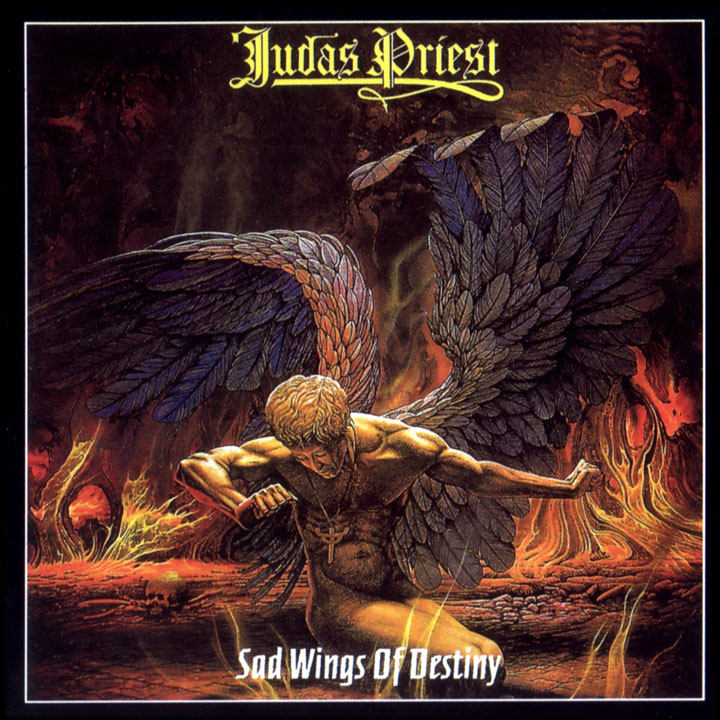
The band participated more in the production of their next album, recorded during January and February 1976, and chose the producers themselves. The result, Sad Wings of Destiny (1976), included a variety of old material, including the aforementioned stage favorites and the epic "Victim of Changes". This song was a combination of "Whiskey Woman", a stage classic from the Al Atkins' era of Judas Priest, and "Red Light Lady", a song that Halford had written with his previous group, Hiroshima. This album and a strong performance at the 1975 Reading Festival helped to raise wider interest in the band and extend their fanbase.
 K. K. Downing and Ian Hill had known each other since early childhood, as they lived near one another and attended the same nursery and school in West Bromwich. They became close friends in their early teens, when they shared similar musical interests (Jimi Hendrix, The Who, Cream, The Yardbirds) and learned to play instruments. The band was founded in 1969 in Birmingham, England, after a local ensemble named Judas Priest (after Bob Dylan's song "The Ballad of Frankie Lee and Judas Priest" from the John Wesley Harding album) split up. The band's singer, Al Atkins, approached Downing and Hill, who were playing as a power trio with drummer John Ellis, and asked if he could become their singer. With Atkins now in the band, Downing suggested they change their name to Judas Priest as he had been a fan of the original band.
 With Downing as acting leader, the band moved away from their original blues influences to play hard rock and what would later come to be defined as heavy metal. This quartet played around Birmingham and the surrounding areas with various drummers until 1974, sometimes opening for bands such as Budgie, Thin Lizzy and Trapeze. Eventually, financial difficulties and problems with their management, Tony Iommi's company, IMA, led to the departure of Alan Atkins and drummer Alan Moore.
At the time, Ian Hill was dating a woman from the nearby town of Walsall who suggested her brother, Bob Halford, be considered as a singer. Halford joined the band, bringing drummer John Hinch from his previous band, Hiroshima. This line-up toured in the UK, often supporting Budgie, and even headlining some shows in Norway and Germany.
 Judas Priest are a Grammy Award winning English heavy metal band from Birmingham, formed in 1969. Judas Priest's core line-up consists of vocalist Rob Halford, guitarists Glenn Tipton, K.K. Downing, and bassist Ian Hill. The band has gone through several drummers over the years, though Scott Travis has held the position since 1989. They have been cited as an influence on many heavy metal musicians and bands. Their popularity and status as one of the definitive heavy metal bands has earned them the nickname "Metal Gods" from their song of the same name. They have sold over 35 million albums worldwide.
Create a playlist at MixPod.com


